

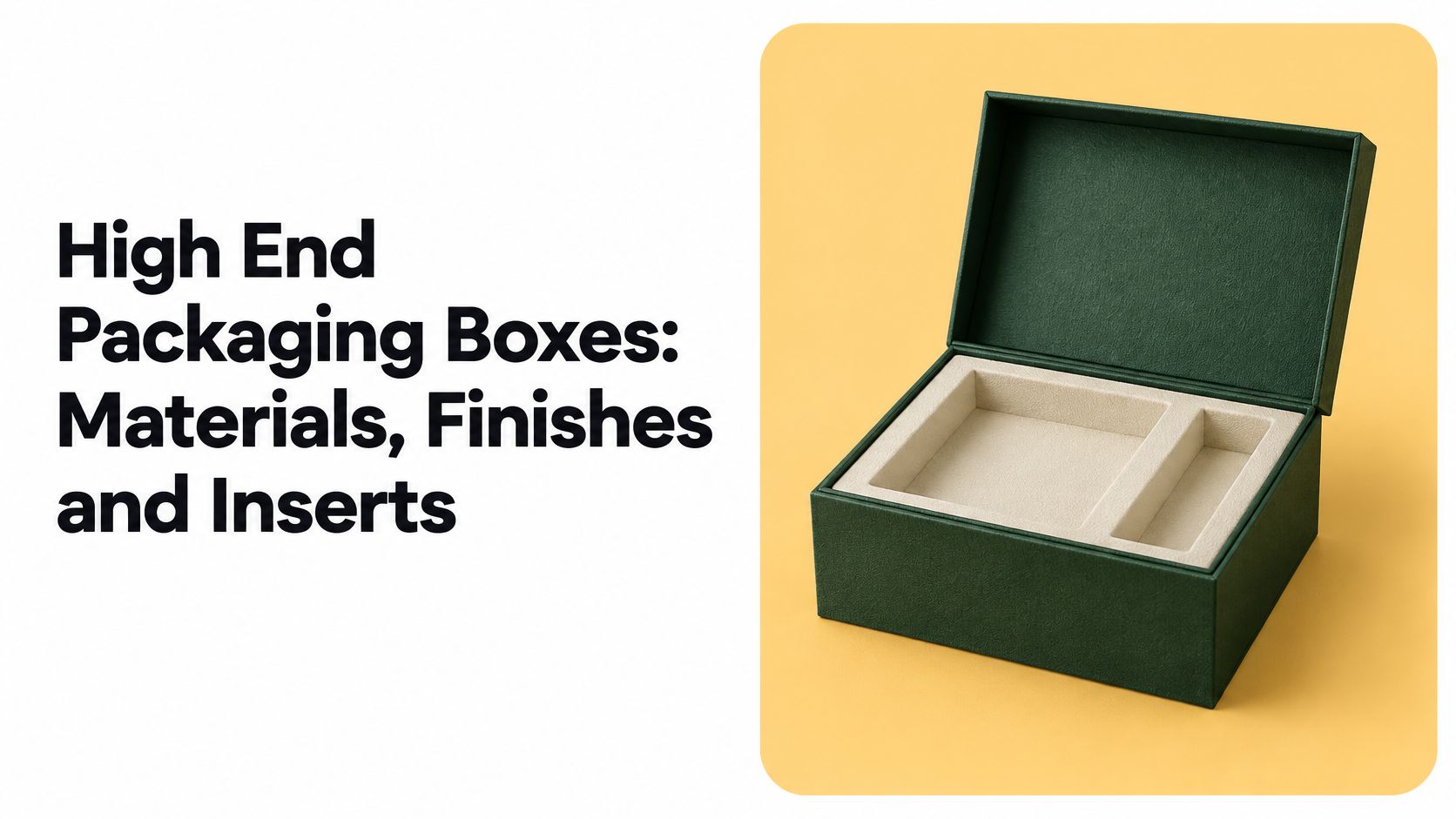
You're holding two samples that share the same navy and the same logo. One lid drops, and the bottle shifts. The other stays shut with a quiet click, and nothing moves when you tilt it. That gap is what a buyer feels in the first few seconds, and it's also what a parcel punishes if nobody checked the stack.
High end packaging boxes fail in two opposite ways. Some look rich and arrive dented. Others survive the truck and feel like a mailer with a sticker. I would treat the pack as one system: structure, board, wrap, finish, insert, closure, and what happens after the product is gone. Luxury isn't a thicker board on its own. It's protection, a clean open, and a second use that still looks intentional.
Table of Contents
- What Makes a Box Feel High End
- Box Structures and Where Each One Fits
- Materials and Wraps That Carry Premium Weight
- Finishes That Signal Quality Without Hurting the Box
- Inserts and Closures That Protect and Present
- How to Test a Premium Box Before Production
- Designing Premium Boxes That Are Recyclable
- Confirm Which Premium Features Earn Their Place
What Makes a Box Feel High End
A premium box is judged on structure, board, finish, insert and closure working together, not on one expensive material.
A buyer lifts the lid. A magnet clicks, a foil logo catches the light, and the product sits in a cradle that doesn't shift.
A custom suit offers a useful comparison. The cut is more important than the label on the fabric, and a good fit conceals the seams. People notice three signals before they notice the story on the panel.
- Weight in the hand: A dense core reads as quality before anyone reads the copy.
- How the lid moves: It should resist slightly, then sit flat, without a wobble or a harsh snap.
- How the product is held: No rattle, no force to lift it out, and no empty corners around it.
A luxury box still has to survive shipping. Plenty of premium boxes fail exactly there, because the design was signed off from a render and a swatch. Once you can name the structure, the board, the finish, the insert and the closure, you can also say which features earn their cost and which ones are only decoration.
Box Structures and Where Each One Fits
Paperboard is the foundation of most high end packaging boxes. It already dominates major markets, and it supports rigid boxes, folding cartons, sleeves and inserts.
In the European Union, packaging waste reached 84.3 million tonnes in 2021, equal to an average of 189 kilograms per resident, and paper and cardboard represented 40.3% of that total, according to the European Parliament overview of packaging waste. About 64% of EU packaging waste was recycled that year. A heavy, composite gift box has to justify that material against a system already built around fibre.
Six formats, one decision
A rigid set-up box is the hardcover. Greyboard, wrapped in printed paper and assembled by hand, suits fragrance, jewellery and gifts. It is the heaviest to ship, and the corners show every wrapping flaw.
A folding carton is the paperback that ships flat. Printed paperboard, die-cut, fits retail packs, supplements and beauty. Perceived weight is lower, so print and finish carry more of the impression.
A magnetic-closure rigid box puts a magnet in the lid or flap for gift sets people open again. That metal has to be separated before the fibre is recycled.
A drawer box is a sliding tray inside a rigid sleeve, useful for kits. You now control two parts, and the gap between them is a tolerance.
A sleeve over an inner box is a jacket on a book you already have. It upgrades an existing pack, and it only looks as strong as the box underneath.
A rigid mailer is a stiff outer shipper with a printed face for direct-to-consumer. Release it only after stacking and drop tests.
| Structure | How it is built | Best for | Main trade-off |
|---|---|---|---|
| Rigid set-up box | Greyboard core wrapped in printed paper, assembled by hand | Fragrance, jewellery and premium gifts | Heaviest to ship, and corners need careful wrapping |
| Folding carton | Printed paperboard die-cut and shipped flat | Retail packs, supplements and beauty products | Lower perceived weight, so print and finish carry more of the impression |
| Magnetic-closure rigid box | Rigid box with a magnet in the lid or flap | Gift sets and repeat opening | The metal magnet must be separated for recycling |
| Drawer box | Sliding tray inside a rigid sleeve | Multi-item sets and kits | Two parts to fit, and more tolerance to control |
| Sleeve over inner box | Printed wrap slid over a tray or box | Upgrading an existing pack | Looks only as strong as the inner box |
| Rigid mailer | Stiff outer shipping box with a printed face | Direct-to-consumer shipping | Must pass stacking and drop tests before release |
Ask three questions before you lock a format. How often will someone open it? How many components does it hold? Does it ship alone, or inside another carton?
Practical rule: If the box will be reopened or kept, favour a rigid structure. If it is a single-use retail pack, a folding carton usually delivers the look with less material.
Materials and Wraps That Carry Premium Weight
The weight in the hand comes from the core and its caliper. The wrap controls colour, grain and touch. Judging a box by the grams of the wrap is the mistake that shows up at the corners. A thin sheet over a weak core crushes at the edges and telegraphs every dent.
Say a fragrance rigid box uses a greyboard core under textured art paper, so it feels soft and dense. A supplement folding carton uses solid bleached sulfate so the colour stays bright and the type stays sharp. Recycled paperboard lowers the virgin-fibre demand, and the greyer base narrows the colours you can hold. An uncoated face is sometimes the better call than another laminate, which is the case we walk through for kraft paper box packaging.
| Material | Where it is used | Strength | Watch-out |
|---|---|---|---|
| Greyboard (chipboard) | Rigid box cores and lids | Flat, stiff and economical | Edges crush if not wrapped carefully |
| Solid bleached sulfate (SBS) board | Folding cartons needing bright colour | Crisp, white print surface | Less suited to recycled-content claims |
| Recycled paperboard | Folding cartons and sleeves | Lower fibre footprint | Greyish base limits colour range |
| Textured art paper | Outer wraps on rigid boxes | Tactile grain and wide colour range | Can crack at fold lines if the grain runs the wrong way |
| Cotton or rag paper | Hero wraps and gift boxes | Soft, luxurious hand feel | Costly, with limited sheet sizes |
| Soft-touch laminate | Coated wraps for a velvet feel | Scuff resistance and matte finish | Complicates recycling and can affect glue bonds |
Core, then wrap, then the corner
- Choose the core for stiffness and how flat the panels stay.
- Choose the wrap for colour, grain and hand feel.
- Check the bond and the fold at the corners, including grain direction.
We write the board name, the caliper and the wrap specification into the spec before anyone prices the run. If those three lines are missing, the sample you liked won't match the production lot. Cotton and rag papers feel exceptional on a hero face, and they also come in limited sheet sizes, so the dieline has to respect the sheet, not the other way around.
Finishes That Signal Quality Without Hurting the Box
A finish is a signal of care that people read in seconds. It is also a change to the material stack. Laminates, coatings and foils alter fold behaviour, glue bonds and crease cracking, so the corner check on the wrap has to be repeated on a finished panel, not on bare board.
Gold foil on a deep navy matte panel reads as premium. The same foil on a dark, heavily covered panel disappears into the ink. Put the finish on the logo, the product name, or one hero panel. Covering every face raises cost and makes fibre recovery harder.
Decorative finish must not cover quantity, identity or other required information. We treat that as a layout rule. Readable type, a distinct variant name and a consistent face still have to survive the embellishment.
| Finish | What it does | Where it works | Watch-out |
|---|---|---|---|
| Foil stamping | Adds a metallic highlight | Logo or product name | Disappears on dark, heavily covered panels |
| Embossing | Raises an area into relief | Logo or single hero panel | Needs enough board caliper to hold the relief |
| Debossing | Presses an area in | Logo or name on a plain surface | Can crack at fold lines if placed on a crease |
| Spot UV or gloss varnish | Adds contrast between glossy and matte areas | Graphic highlights on a matte base | Adds cost and can complicate recycling if it covers whole panels |
| Matte or soft-touch laminate | Gives a quiet, velvet-like surface | Whole outer wrap | Complicates recycling and can affect glue bonds |
| Holographic foil | Adds a striking accent | Small accent on a brand mark | Reads as cheap if overused |
Where each mark belongs
Foil stamping is a metallic highlight, best kept to a logo or name. Embossing lifts that same mark into relief, and it needs enough caliper or the relief collapses. Debossing presses the mark in, and it cracks if you park it on a crease.
Spot UV or a gloss varnish creates contrast on a matte base. Use it on a graphic highlight, not a full flood, or you pay twice, once in cost and again in recycling. A matte or soft-touch laminate quiets the whole wrap and scuffs less in handling, and it can fight the glue at the turn-in. Holographic foil is a small accent on a brand mark. Spread it across a panel and it stops reading as craft.
Approve a physical finished panel before you release art. A render can't show crease crack, foil adhesion or a glue failure at the corner.
Inserts and Closures That Protect and Present
The insert is the part someone touches every time they use the box. Structure and print set the mood. The cradle decides whether the product feels placed or dumped in.
Design to the product's real dimensions and weight. Leave enough clearance that it lifts out without force and still doesn't rattle. We ask for measurements, weight, and a sample where you have one, because a description isn't a fit check. Structural work also has to cover the closure, the insert, the assembly steps, and how the packed box sits in a shipping carton.
- Molded pulp cradles: Fibre, shaped to the product, and usually the easiest insert to recover with the box.
- Die-cut foam or EVA: Excellent hold for heavy or fragile goods, and a plastic that the fibre stream doesn't want.
- Paperboard trays with cut-outs: A good middle path for kits, as long as the slots match the actual part, not the CAD average.
- Wrapped card or tissue: Fine for light goods and gifting, and useless as the only restraint on anything that can shift.
Closures and a four-drawer set
A magnetic flap, a ribbon tie, a tuck end and a snap lid don't behave the same in the hand or at end of life. A magnet is a second material that has to come out. A tuck is all fibre and weaker on repeat opening. A ribbon adds labour and a loose component in the shipper.
Small glass makes the tolerance obvious. A vial box has to stop the glass walking without pinching the cap. Say a gift set uses four drawers inside one outer box. Each insert has to hold its item when that outer carton is stacked, not only when a drawer sits open on a table.
Check three things on the packed sample.
- Tilt: Does the product move when the box is tilted?
- Repeat close: Does the lid sit flat after you open it several times?
- Assembly time: Can the pack be completed in under a minute?
If any answer is no, change the insert or the closure before you add more decoration.
How to Test a Premium Box Before Production
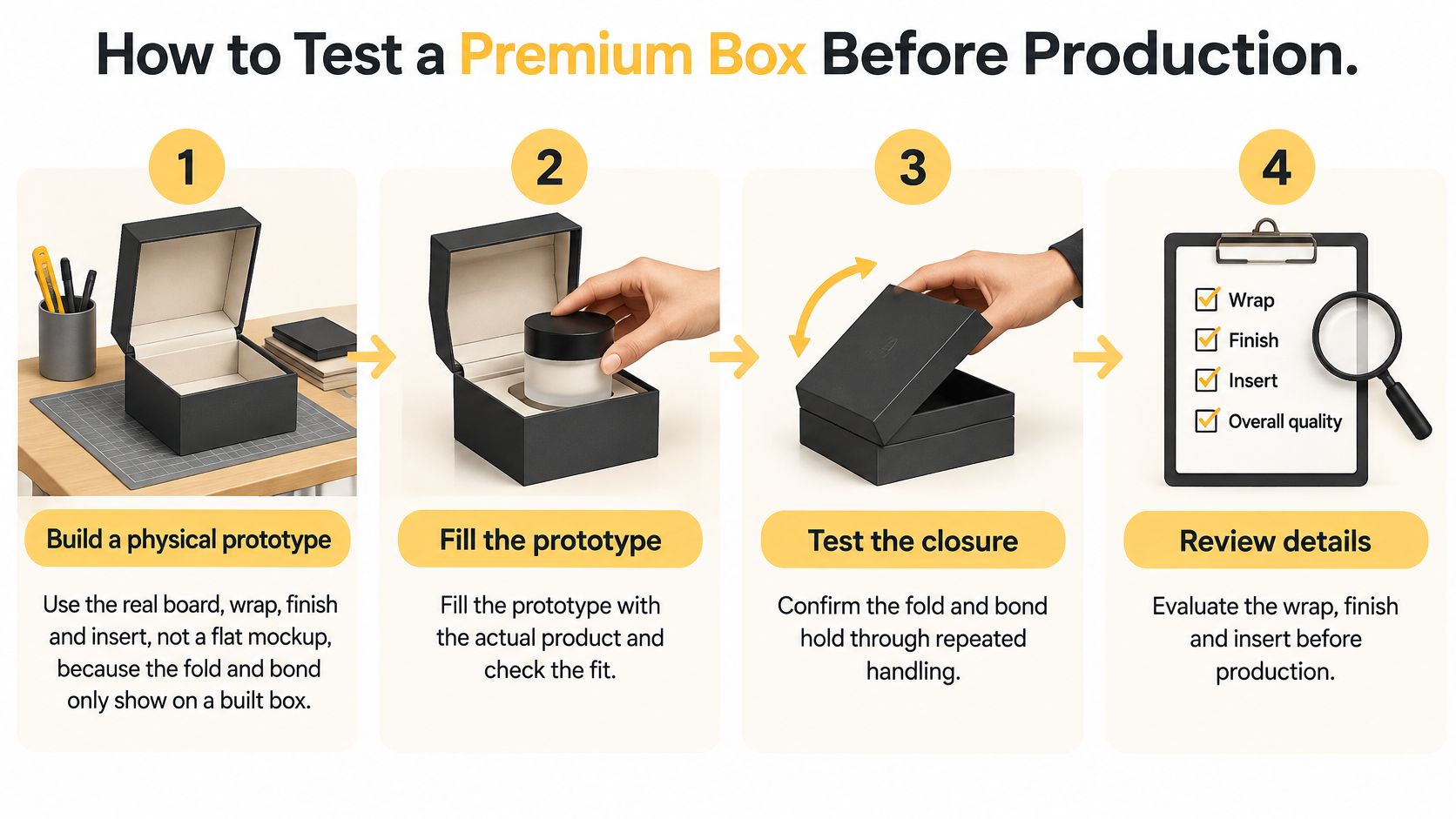
Looks aren't a test method. Build the actual construction, load it, and write down how it failed.
The sequence below is the short version of that protocol, from a built sample through to the details you inspect before a production commitment.
Premium presentation pushes brands toward thick boards, trays and extra parts. In a Bain & Company survey of 561 executives across the luxury-packaging chain in Europe, the Middle East and Africa, reducing packaging volume and weight to maximize transport loads and minimize journeys was the leading priority for supply-chain sustainability. Half of those respondents expected sustainable products to represent more than 30% of luxury-packaging sales within the following three years. A test that ignores empty space is testing the wrong box.
Eight checks before you commit
- Build a physical prototype with the production board, wrap, finish and insert. Fold and bond only show on a built box. The slip is approving a flat mockup.
- Fill it with the actual product and weigh it. Insert fit follows true mass, not a stand-in of the wrong weight.
- Check function. The lid should close flat, the magnet or tuck should hold after ten openings, and the insert should keep the product when you tilt the box. One gentle open on a desk isn't a test.
- Set the stack load from the weight and number of packages above the unit. ISTA guidance cites a nominal stacking density of approximately 200 kg/m³ for mixed loads, with factors for temperature and untested hazards, and it isn't interchangeable with other methods: ASTM D642 uses a platen speed of 12.5 mm/min, while ISO 12048 specifies 10 ± 3 mm/min. The slip is stacking three samples on a bench and calling it a pallet.
- Write the method on the spec, including platen speed, so a later lab isn't compared with a different test.
- Condition the samples in the humidity and temperature they'll see in storage, then repeat. Fibre board loses strength when it takes on moisture. A dry-day pass is the slip.
- Inspect corners, wrapped edges, hinge lines, magnets and the insert, and record the failure mode, not only the peak load. Smithers compression testing covers failure loads and sustained stacking, including behaviour over longer storage rather than an instantaneous peak. A box that stays upright and shows lid misalignment can still fail at retail.
- Prove one assembled size, then extend. We review a physical prototype, with detailed specifications and 3D mockups, before the structure is committed. After that proof, check smaller containers, longer statements and other formats. Scaling a hero size to a whole range without rebuilding one variant is how tolerances drift.
A passing prototype has a flat lid, intact corners, a product that stays put, and a recorded method. On the finished lot, Supply Automate's pre-shipment inspection guide is a practical list for what to look at before goods leave, separate from the lab compression number.
Designing Premium Boxes That Are Recyclable
Foil, magnets, ribbons, coatings, laminated papers and foam can make an otherwise paper box hard to sort. The hard problem isn't picking a board that sounds responsible. It's the architecture around that board.
What to take apart
Match the box to the product so you aren't shipping air. Cut any component that doesn't protect or present. Keep magnets and other hardware removable. Choose adhesives and coatings that don't block fibre recovery. Record every material on one specification sheet so a claim can be checked against the actual pack.
Compare two builds. A rigid box with a removable magnet and a fibre insert can be separated and documented. A fully laminated box with a bonded foam tray arrives as one composite. The first is easier to explain to a mill and to a retailer. The second may look polished and still be a reject at sorting.
A paper box that breaks in transit is a worse result than a sturdier box that arrives intact. Protection belongs in the environmental case.
The EU Packaging and Packaging Waste Regulation applies from 12 August 2026. Brands selling into the EU need composition and recyclability documented throughout the life of the pack, and a US claim still has to match what local collection will take. Swapping every part for paper is not necessarily better if the pack then requires more material, or if it is discarded after one damaged trip.
The choices that hold up are the ones you can specify, not a green panel on a composite. We keep that question inside the structural brief, alongside the wider shifts covered in our note on sustainable packaging trends for 2026.
Confirm Which Premium Features Earn Their Place
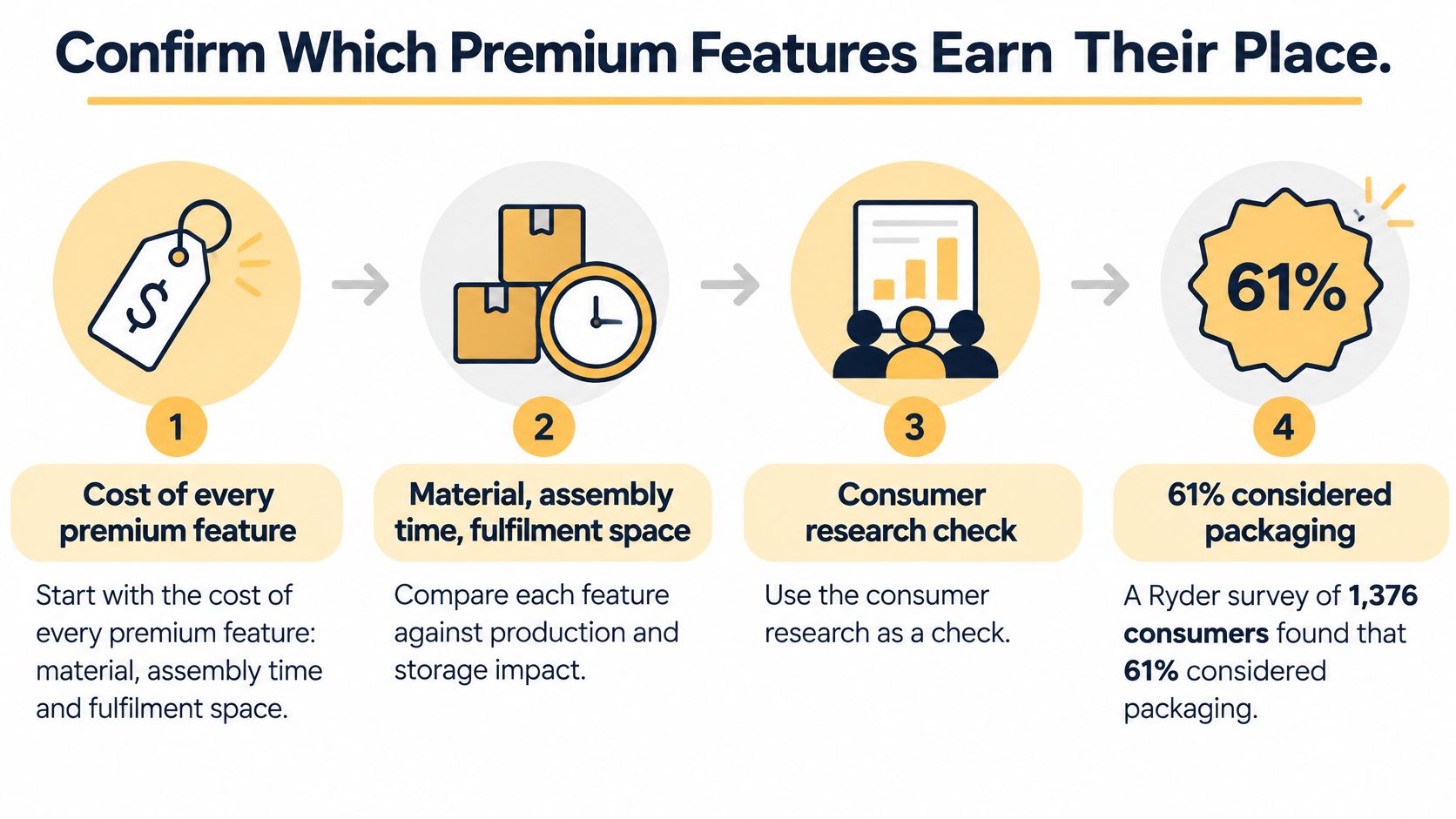
Every premium feature costs material, assembly time and fulfilment space. If it doesn't protect the product or earn a second use, it's disposable theatre.
A Packaging Dive report on a Ryder survey of 1,376 consumers found that 61% considered packaging sustainability when making online purchases, up from 54% in 2023. Respondents chose boxes primarily because they perceived them as better for transit protection (36%) or reusable (29%), while only 14% selected them because they believed boxes were more eco-friendly. Shoppers still look for custom boxes and exterior details such as ribbons or twine. Protection and continued use can matter more than decoration, so a box that becomes storage, gifting or display extends its value past the first open.
Use the checklist as a filter before you add another layer.
| Feature | Earns its place when | Skip it when |
|---|---|---|
| Magnetic closure | The box is opened repeatedly as a gift or keepsake | The box is single-use retail or mailer packaging |
| Fitted insert | The product is fragile, heavy or irregularly shaped | The product is light and a fold-in card holds it |
| Ribbon or twine | Gifting or display is part of the sale | Mass-market shipping at high volume |
| Foil or embossing | A logo or name must be the first thing seen | The panel is dark and heavy, so the effect disappears |
| Drawer structure | The set has several components to separate | The box holds one item in a simple form |
| Reuse-ready structure | The product lives on a shelf or drawer after opening | The product is consumed quickly and the box has no second use |
Score the feature, then write the brief
Score each feature against the product's value, its damage risk and its reuse potential. If two of the three are weak, leave it off. A magnetic closure on a keepsake is worth the metal. The same magnet on a single-use mailer is not. A fitted insert earns its place around a heavy or odd-shaped product, and it's waste when a fold-in card already holds a light one.
Before you ask any studio for quotes, write a brief that states dimensions, weight, components, quantities, artwork responsibilities and approval steps. We treat that brief as part of whether the project is credible. Foil, deboss and emboss are offered on the right stock, and specialty laminates include soft-touch, matte and holographic. If you have a project in mind, talk the brief through with the studio before you commit to a format.
Mylarmen engineers high end packaging boxes as one system, from structure, inserts and closures through finishes and a physical prototype, then manages production under one roof. Bring the product weight, the components and the approval steps, and we'll tell you which features earn a place on the pack. Visit Mylarmen to talk through the brief before you lock a format.