

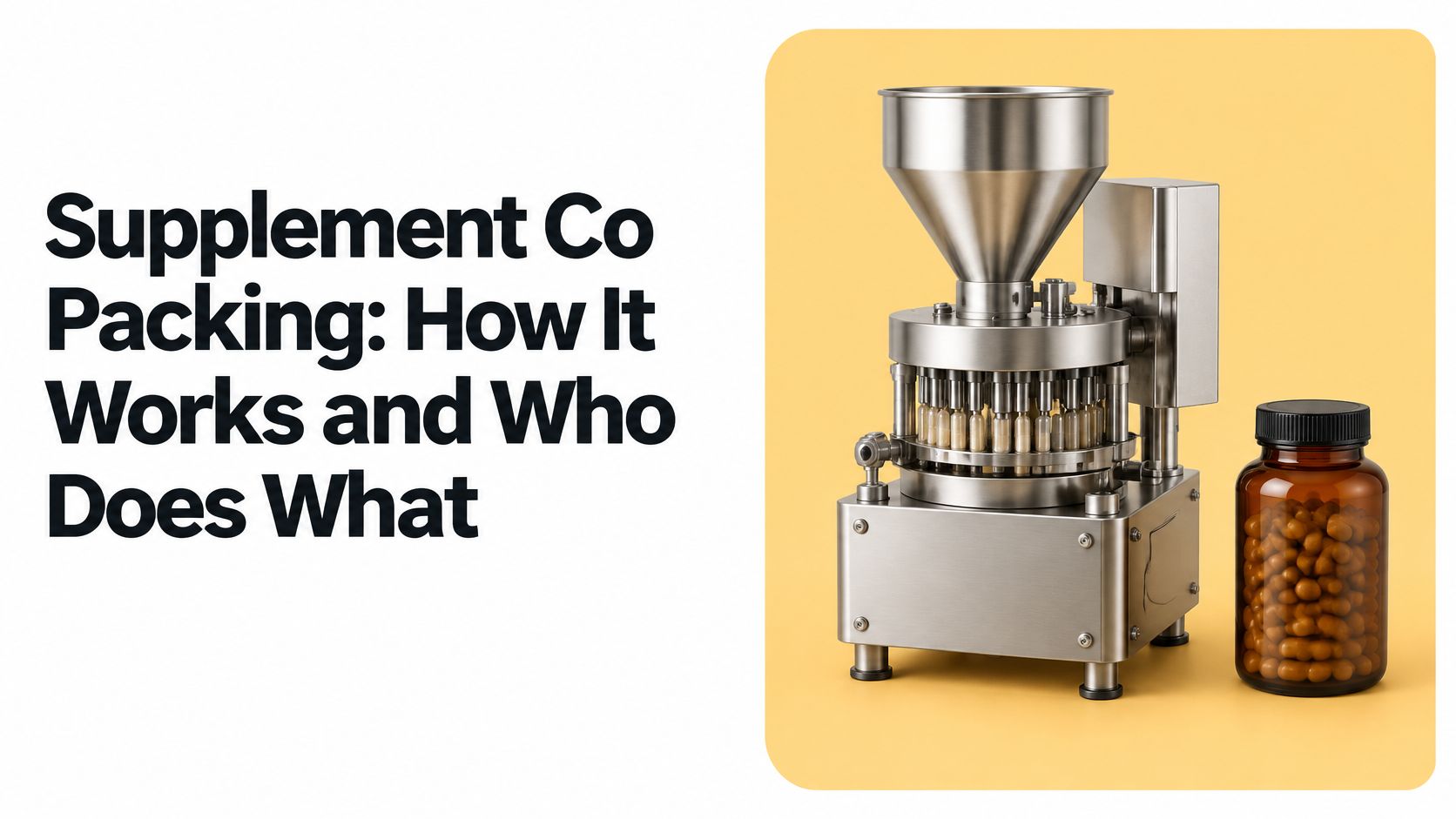
You've finalized your supplement formula, lined up your first retail buyers, and started collecting quotes from packaging facilities. On paper, the handover looks simple: you send a purchase order, the factory fills your bottles or pouches, and finished inventory arrives at your warehouse. Then the operations manager asks for your master product specifications, approved artwork revision number, supplier qualification records, and batch-release criteria.
That moment catches many emerging brands off guard. Supplement co packing isn't a passive outsourcing deal where a signed contract transfers compliance and quality risk to the factory floor. It operates as a shared accountability system. Your initial brief, the production run sequence, the packaging specification, and the final release file must all trace back to one documented batch, and every partner in the chain has concrete records to maintain.
Table of Contents
- What Supplement Co-Packing Means and Why It Grew
- Who Owns What When a Brand Uses a Co-Packer
- How a Co-Packing Run Moves From Brief to Release
- Packaging Coordination From Artwork to Finished Pack
- Batch Records, Testing and Release Decisions
- Designing One Package for Several Markets
- Confirm the Brief Before You Sign With a Co-Packer
What Supplement Co-Packing Means and Why It Grew
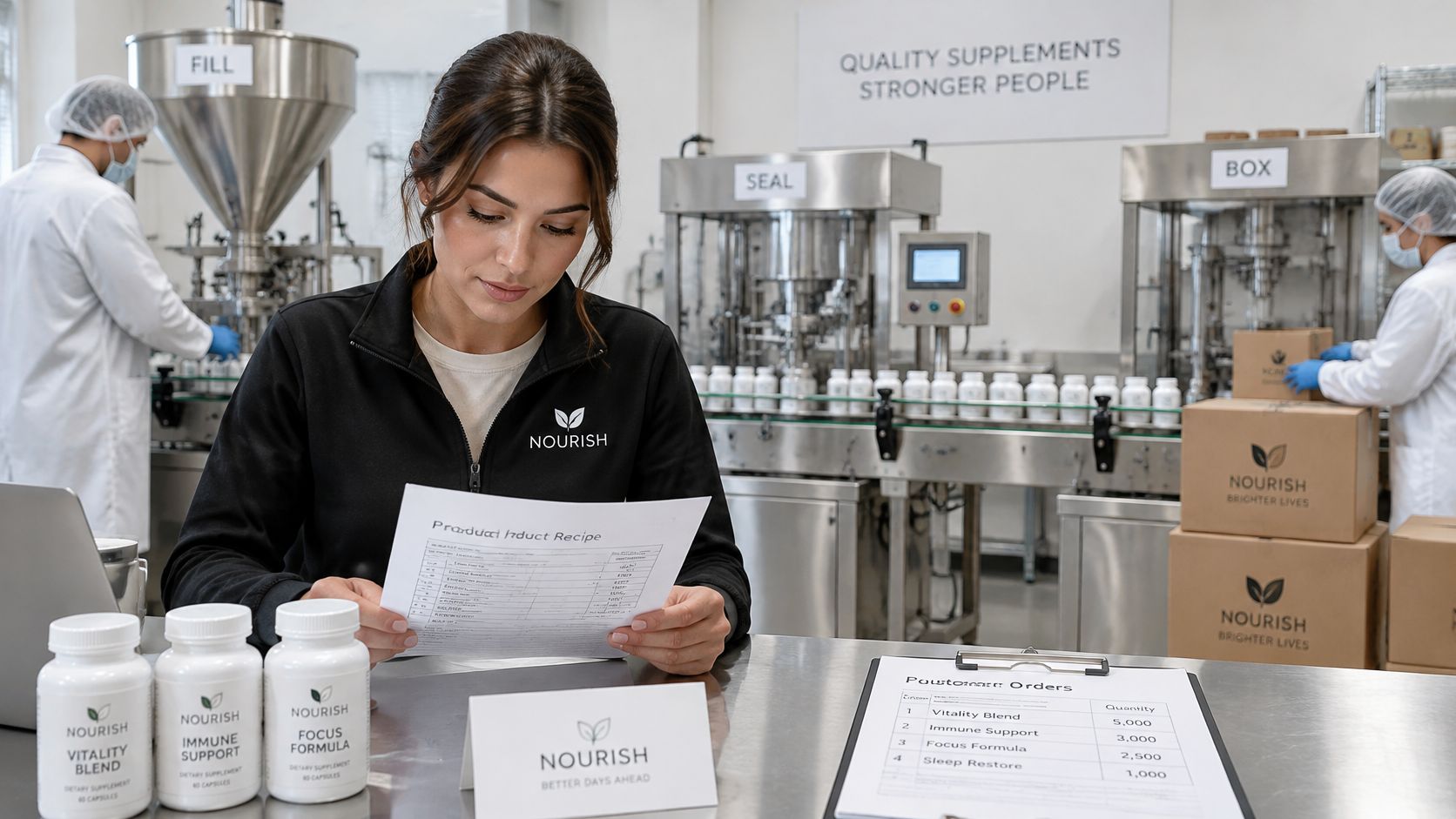
Think of a supplement co-packer like a shared commercial kitchen rented by a specialty food maker. You keep ownership of the recipe, the brand identity, and the customer relationship. The facility provides the filling equipment, trained line operators, sanitation protocols, and production scheduling so you don't have to build a plant from scratch.
In plain terms, supplement co-packing is the service where a specialized facility formulates, fills, packages, labels, or holds finished dietary supplements under another company's brand name.
Co-Packing Versus Contract Manufacturing and Private Label
Founders often use four production terms interchangeably during early vendor calls, which leads to mismatched quotes. Separating them saves weeks of email back-and-forth:
- Contract manufacturing: The broadest umbrella covering custom formulation, raw ingredient sourcing, blending, tableting or encapsulation, and finished packaging.
- Co-packing: Focuses primarily on filling, sealing, labeling, and secondary cartoning using either bulk product you supply or a blend produced in-house.
- Turnkey co-packing: Expands standard co-packing so the facility also sources your containers, closures, pouches, and printed labels alongside production.
- Private label: Places your brand name and artwork onto an existing stock formula already developed and stocked by the manufacturer.
Shared production capacity grew rapidly as supplement shelves fractured into thousands of niche formats. Following the Dietary Supplement Health and Education Act of 1994, an FDA compliance document reported that the U.S. dietary supplement market expanded from approximately $4 billion in 1994 to more than $40 billion in 2019, a tenfold increase over 25 years. Over that same span, the estimated product count jumped from roughly 4,000 products in 1994 to between 50,000 and more than 80,000 in 2019, supported by a global supply chain spanning more than 10,000 facilities. Worldwide demand shows no sign of slowing either: Emergen Research valued the global dietary supplements contract manufacturing market at USD 16.85 billion in 2025 and projects it will reach USD 41.50 billion by 2035.
Consider two everyday launch scenarios. Say a gummy brand launches five flavors and runs one batch per flavor on a shared rotary depositor and bottling line, keeping separate labels and batch records for each SKU without buying a single machine. Or picture a sports nutrition brand testing single-serve protein sachets for travel retail before committing capital to a dedicated vertical form-fill-seal machine. In both cases, specialized co-packing makes multi-SKU launches financially viable while placing real coordination duties on the brand owner.
Who Owns What When a Brand Uses a Co-Packer
Small brands frequently assume that hiring a facility with Good Manufacturing Practice (GMP) certification hands regulatory accountability over to that partner. It doesn't. Under U.S. law, the company whose name sits on the label remains responsible for ensuring every distributed unit meets federal safety, identity, and labeling standards.
That gap carries real market consequences. The FDA's 2025 health fraud recall listings documented dietary supplements pulled from shelves for containing undeclared pharmaceutical ingredients including sildenafil, tadalafil, dexamethasone, diclofenac, and omeprazole, while broader federal recall records point to contamination and insanitary storage failures. Selecting a certified facility is a strong starting point, not an insurance policy. Your business still needs documented product specifications, supplier qualification records, testing plans, change-control rules, batch-release criteria, complaint handling logs, and a written recall procedure.
Choosing an audited co-packer reduces operational friction, but regulatory accountability stays attached to the brand owner on the label.
A clean division of duties across every partner prevents fingers from pointing when something goes wrong on the line. The matrix below maps how typical responsibilities split across the four parties involved in a supplement co packing run.
| Task | Brand owner | Co-packer | Packaging supplier | Testing lab |
|---|---|---|---|---|
| Specifications and master records | Approves final specifications | Maintains the master manufacturing record | Supplies component specifications | Usually not involved |
| Ingredient and component identity | Approves qualified suppliers | Verifies each incoming lot before use | Provides certificates and documents | Runs identity tests when agreed |
| Packaging and artwork | Supplies approved artwork and mandatory statements | Checks containers and closures against specification | Produces components to tolerance | Usually not involved |
| Finished-batch testing | Sets test scope and release criteria | Holds the batch until results are reviewed | Not involved | Performs specified tests and reports results |
| Labelling and lot coding | Owns label content and claims | Applies the correct label and lot code | Supplies label stock | Usually not involved |
| Complaints and recalls | Leads decisions and external communication | Traces affected batches and supports action | Supplies lot information for components | Re-tests retained samples |
Four Questions to Settle in Your Quality Agreement
Verbal assurances from a friendly sales representative won't protect a batch when an ingredient shortage hits or a potency test fails. Put clear written answers to four practical questions inside both your supply agreement and your quality agreement before issuing a deposit:
- Substitute ingredient approval: Define in writing who holds authority to approve an alternate raw material or vendor, and require signed brand sign-off before any substitution touches the blender.
- Label claim verification: Clarify who checks finished label statements against the final formula, serving size, and regulatory rules so marketing claims never outrun the tested formulation.
- Failed batch financial liability: Spell out who absorbs ingredient, packaging, and labor costs if a batch fails testing because of raw material contamination, line errors, or out-of-spec packaging components.
- Facility and subcontractor audits: Confirm your right to audit the primary co-packing facility on reasonable notice and require written disclosure before the co-packer subcontracts any step such as stick-pack filling or third-party labeling.
Treat the responsibility table above as a working draft rather than a fixed rulebook. Edit each cell with your operations team and legal counsel so your final quality agreement reflects the exact tasks your co-packer performs.
How a Co-Packing Run Moves From Brief to Release
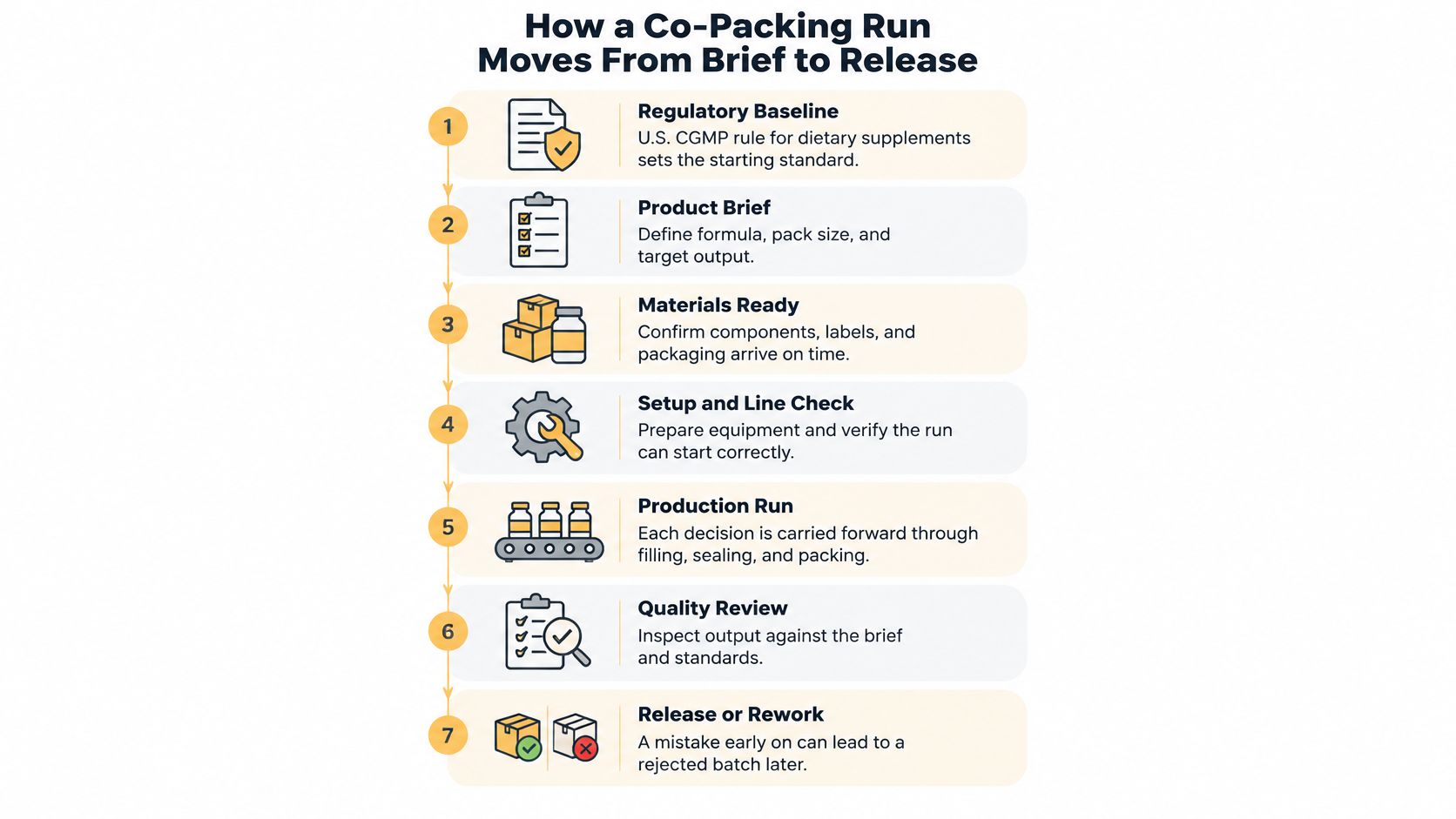
A production run works like a chain of handoffs. A vague formula, an unclear artwork owner, or a late component change can sit during onboarding, then appear later as a stopped filling line or a quarantined batch.
In the United States, the operating baseline comes from federal requirements. On June 25, 2007, the FDA issued its final Current Good Manufacturing Practice (CGMP) rule for dietary supplements in Volume 72 of the Federal Register, pages 34,752 to 34,958. That rule established 21 CFR Part 111, which took effect on August 24, 2007. Because the regulation covers packaging, labeling, and holding alongside manufacturing, a compliant co-packer maintains written specifications, a master manufacturing record, at least one appropriate identity test on each incoming dietary ingredient lot before use, and finished-batch checks for identity, purity, strength, composition, and contamination limits.
Think of these records as the production equivalent of a recipe card, a delivery receipt, and a final quality stamp combined. The co-packer may run the line, but the brand still owns the clarity of the brief, the approval of packaging, and the release decision. A signed contract divides tasks. It does not transfer accountability for a batch that cannot be traced back to one documented set of instructions.
Eight Stages From Initial Brief to Batch Release
Every commercial supplement run passes through eight sequential checkpoints. Skipping verification at one stage usually creates rework at another, because the next department has to improvise around the missing decision.
Write the production brief: Document your formula, SKU list, target quantities, pack format, and named artwork owner so every vendor quotes against identical assumptions. Product measurements, weight, and samples where available help the packaging team judge structure before artwork begins. Common slip: Handing over a brief that omits who builds and approves the print-ready artwork files.
Build written specifications: Establish measurable parameters for each finished product, raw material, container, closure, and label. Mylarmen packaging projects receive detailed specifications and 3D mockups before production, a discipline explained in its guide on how to structure packaging design. Common slip: Specifying a stand-up pouch by outer height and width while leaving out the barrier film structure or material grade.
Qualify suppliers and approve components: Review supplier documentation and test incoming lots before releasing materials to the production floor. Pouches, cartons, boxes, sleeves, and inserts all need to match the pack format in the specification. Common slip: Allowing an unapproved substitute ingredient into the blend to cover a sudden supply shortage.
Run a development sample and trial batch: Test how the powder flows through the auger filler or how capsules feed into bottles, then measure trial output against the written specification. A useful trial looks past the tidy jar on the table and asks whether the filling method can repeat the result. Common slip: Judging the pilot run solely by appearance.
Approve the master manufacturing record and physical master sample together: Lock step-by-step production instructions alongside a signed, physically assembled reference pack. That reference should account for closures, inserts, assembly steps, and how packs sit in a shipping carton, so line operators and inspectors share one benchmark. Common slip: Signing off on a physical sample before updating the written master record to match a late cap or scoop change.
Execute production with in-process checks: Monitor fill weights, induction seal integrity, torque settings on closures, and label alignment at defined intervals throughout the shift. Each setting change needs a matching entry in the batch record, just as a driver logs miles and fuel stops on a long route. Common slip: Moving from one flavor or SKU to the next without completing and logging a formal line-clearance check.
Inspect finished packs prior to distribution: Visually verify packed units against the master specification to confirm that the exact container, closure, label version, and lot code match the batch documentation. Common slip: Discovering during palletizing that operators pulled labels printed from an older artwork file.
Test the finished batch and authorize release: Review laboratory results, packaging reconciliations, and in-process logs inside a formal batch release file before shipping a single case. The release file should tie the brief, run sequence, packaging specification, and batch record to the same lot. Common slip: Releasing finished inventory on a quick visual check while laboratory results are still pending.
Seeing a Production Floor Setup in Practice
Reading checkpoints is helpful, yet watching filling equipment, line changeovers, and inspection stations work together clarifies why documentation matters at every handoff. The video below walks through supplement packaging operations on an active co-packing line.
Notice how tightly physical equipment setup connects to paperwork. Whenever a crew switches bottle heights, cap liners, or label rolls, each mechanical adjustment requires a corresponding entry in the batch record so finished inventory stays traceable.
Packaging Coordination From Artwork to Finished Pack
Say a supplement brand revises a serving instruction on its label. The graphic designer updates the print file and emails a PDF proof for approval, everyone signs off, and the run goes ahead. Nobody removes the leftover pre-printed pouches sitting in the co-packer's staging bay, and 400 filled pouches roll off the sealer carrying outdated wording.
Preventing that mistake starts with treating packaging as a regulated quality checkpoint rather than a marketing afterthought. Under federal CGMP packaging and labeling requirements, a U.S. dietary-supplement packer must visually identify containers and closures before use and check supplier documentation (such as an invoice, guarantee, or certification) against written packaging specifications. Once packing wraps up, finished units must undergo visual examination before distribution to confirm that the specified package and specified label were applied.
Those two checks catch completely different failure modes. Receiving verification stops wrong pouch films, mismatched bottle neck finishes, and incorrect closures before filling begins. Finished-pack inspection catches line-clearance errors, mixed labels, and obsolete artwork before cases reach a distributor.
| Specification field | What to record | Who checks it | Why it matters |
|---|---|---|---|
| Material and format | Pouch, bottle, jar or carton with material grade | Co-packer at receiving | A wrong format stops the line or causes mismatches |
| Dimensions or capacity | Height, width, fill volume or unit count | Co-packer and packaging designer | Fit and fill accuracy depend on it |
| Closure type | Cap, liner, seal or pump specification | Co-packer at receiving | Closure errors cause leaks and tamper concerns |
| Artwork revision | Version number and approval date | Brand owner before print | Stops obsolete labels reaching the line |
| Mandatory statements | Warnings, dosage, batch and QR information | Brand owner and regulatory reviewer | Missing or outdated statements force relabelling |
| Lot and expiry coding | Location, font and print method | Co-packer at finished-pack inspection | Links each pack to its batch record |
| Inspection criteria | Print defects, label placement and seal checks | Co-packer quality team | Defines what the line rejects |
Moving From Physical Prototypes to Controlled Master Samples
Digital renders look crisp on a monitor, yet they hide real physical problems: a scoop that won't fit through a jar neck, a tear notch placed too close to a zipper track, or a master carton that crushes pouches in transit. Structural packaging design has to account for closures, inserts, assembly steps, and how filled packs sit inside a shipping carton.
Build one representative assembled proof first before rolling the visual system out to smaller jars, multi-pack sleeves, or longer regulatory panels. Always review a physical prototype before committing to tooling or full print runs, converting approved proofs into controlled specifications through a disciplined packaging design mockup process.
Real-world consumer handling also tests structural decisions long after a product leaves the warehouse. Single-serve stick packs and sachets, for example, face repeated bending, altitude pressure shifts, and airport screening; practical guidance like PÛR Creatine's breakdown on flying with creatine monohydrate packets illustrates why durable seal specs, clear ingredient labeling, and intact single-serve pouches matter to everyday buyers.
Keep visual hierarchy practical when adding specialty finishes. Readable text, distinct flavor or variant names, and consistent layout make a supplement easier to use, and decorative touches like metallic foil or spot varnish must never cover net quantity, product identity, or other approved information.
Engineering benchmark: The legally relevant question isn't whether a mockup looks polished in a pitch deck, but whether every manufactured package matches the documented specification.
Batch Records, Testing and Release Decisions
Imagine opening a case of freshly packed capsules. The bottle finish is clean, the foil stamping aligns to the millimeter, and the printed Supplement Facts panel matches your approved PDF. Yet inside the capsules sits a bulk blend containing an undeclared substitute ingredient that slipped past receiving. The label is accurate on paper, while the product inside fails compliance.
That disconnect explains why release decisions rely on a verified chain of batch documentation rather than visual polish. Under the 2024 Title 21 CFR Part 111 text, a U.S. co-packer must operate a documented production and process-control system instead of relying solely on a supplier's certificate of analysis. Every finished batch requires established specifications for identity, purity, strength, composition, and contamination limits verified through scientifically valid tests or examinations.
The quality team must also choose whether to test every single finished batch or apply a statistically sound sampling plan, and record the written rationale supporting that choice. Documentation has to show how supplier qualification, incoming component identity checks, and in-process controls back up any decision not to repeat every analytical test on every finished lot.
Keeping packaging data, SKU attributes, and batch identifiers synchronized across systems reduces manual re-keying errors between brands and contract facilities. Structuring core product attributes in a standardized format, as outlined in the NanoPIM production data sheet guide, helps ensure that the specifications guiding the printer match the numbers logged by the quality team.
What Belongs in the Batch Release File
Before quality control signs off on shipping finished goods, every piece of production and packaging evidence converges in one batch release file. Confirm that your co-packer's release packet accounts for seven mandatory entries:
- SKU and lot code: Connects every finished consumer unit back to one unique batch production record and raw ingredient trace.
- Label version: Verifies that the exact printed label revision applied on the line matches the brand's current approved artwork number.
- Container and closure configuration: Confirms the primary bottle, pouch, induction liner, desiccant, and cap match the controlled packaging specification.
- Fill count or net weight: Documents periodic in-process weight or capsule-count verifications confirming output stayed within target tolerances.
- Printed material reconciliation: Balances total labels or pre-printed pouches issued to the line against finished units packed plus documented spoilage, catching unaccounted rolls before they mix into another run.
- Retained samples: Logs representative finished units placed into controlled storage so an independent lab can re-test them if a customer complaint or regulatory inquiry arises months later.
- Disposition of rejected or held units: Records exact quantities pulled for print defects, poor seals, or under-fills along with documented proof of quarantine, rework, or destruction.
Approved artwork represents just one line item inside that folder. Without reconciled label counts, verified component identities, and passing analytical lab reports, a sharp label proves nothing about the batch inside.
Handling Out-of-Specification Results
When a potency assay drops below target, a microbial count crosses the specification limit, or label reconciliation turns up missing rolls, the release rule is straightforward: stop immediately.
Place the entire batch on formal hold, investigate and record the root cause, and authorize release only with a documented, scientifically valid justification proving the batch meets every established specification.
Releasing a questionable lot under launch deadline pressure turns a manageable internal rework into a public recall.
Designing One Package for Several Markets
A growing supplement brand can use one visual identity across the United States, Canada, and the European Union while still needing market-specific information on the pack. The shared identity works like a family resemblance: the colors, type, and product naming stay familiar, while each market gets the required wording and structure. That distinction matters because a label is part design asset and part production instruction. If the legal copy, units, claims, and language blocks are treated as afterthoughts, one global design can become several expensive problems.
The European Union's Your Europe supplement labelling rules require packages placed on the EU market to declare recommended daily consumption, warn consumers not to exceed the stated recommended daily dose, state that food supplements should not be used as a substitute for a varied diet, carry a child-safety storage statement, and provide a numerical declaration of relevant nutrients or substances. Individual EU member states can also require prior label notification before a product goes on sale. Those requirements shape the pack itself. They decide how much copy fits, where it sits, and whether one artwork file can serve more than one market without creating confusion on the line.
Treating international packaging as a simple translation exercise misses those structural differences. Botanical status, measurement units, health-claim wording, warning placement, and multilingual copy blocks can all shift between jurisdictions. Co-packing becomes a shared accountability system here. The brief, run sequence, packaging specification, and release file must all point back to one documented batch. A signed contract does not move that responsibility away from the brand.
| Approach | How it works | Best when | Main risk |
|---|---|---|---|
| Single universal label | One label used in every market | Markets share mandatory wording | Fails any market with different mandatory statements |
| Modular label panels | Core pack with swappable market panels | Two or three markets with similar rules | Panel swaps must be tracked by lot and version |
| Region-specific packaging | Separate SKUs for each market | Mandatory wording, units or claims differ widely | Higher inventory and larger minimum runs |
| Over-labelling after packing | Market sticker added to a finished pack | Small runs or late rule changes | Extra handling and relabelling errors if uncontrolled |
Hidden Costs and Pre-Artwork Decisions
The lowest per-unit printing quote rarely produces the lowest total cost across several countries. Splitting one formula into region-specific packaging SKUs multiplies warehouse locations, ties up cash in stock that cannot move freely between markets, and forces separate minimum print quantities. A single universal label can create the opposite problem when required statements do not fit or do not match the rules for a destination market. Over-labelling finished bottles adds manual work and creates another chance for a sticker to cover lot codes or required text if line checks are weak.
The practical question is not which design looks cleanest on screen. It is which system remains traceable after the bulk blend is divided, labelled, packed, stored, and released. A modular panel works like a set of interchangeable pages in the same binder. The core pack stays consistent, but each inserted page must match the right market, lot, and version.
Before a multi-market die-line is locked, settle four operational questions with your co-packer and compliance advisor:
- SKU separation: Confirm whether market-specific labels require separate SKU codes in your ERP, warehouse, and batch-record systems so regional stock never commingles.
- Lot and expiry traceability: Define how one bulk blend split across two or three regional label versions preserves unbroken lot and expiry tracking for potential recalls.
- Late regulatory edits: Verify whether your co-packer and print vendor can absorb mid-cycle wording updates without forcing you to scrap an entire run of pre-printed film.
- Multilingual panel footprint: Check early whether adding two or three languages forces a taller bottle or wider pouch, which directly affects tooling, shipping cartons, and minimum print runs.
Packaging design discussions do not establish product safety or market authorization. Their job is to make the physical pack, the printed information, and the batch documentation agree. When those pieces disagree, the brand and the co-packer inherit the same problem, no matter how carefully the artwork was approved.
Confirm the Brief Before You Sign With a Co-Packer
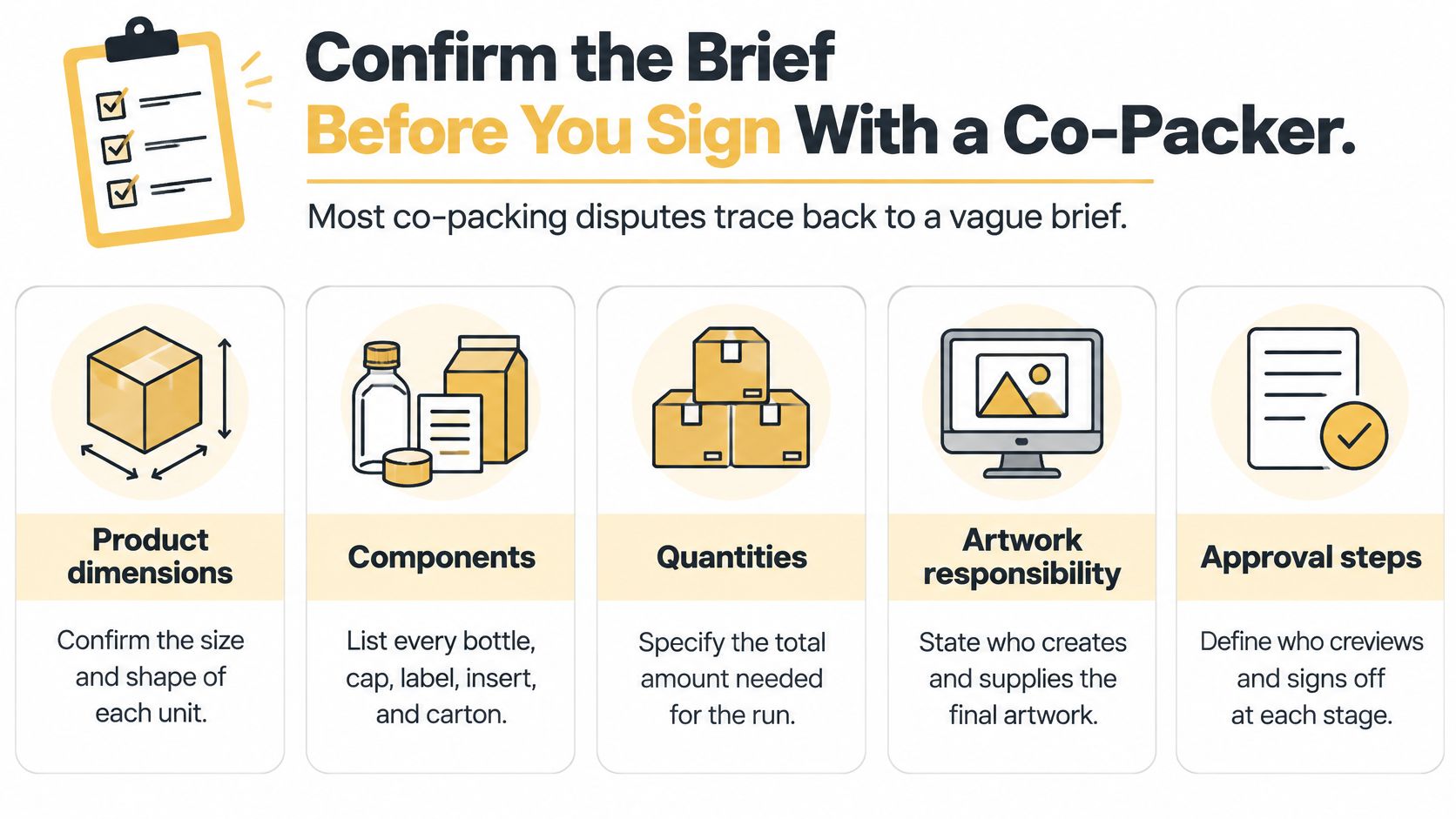
Most supplement co packing disputes, surprise setup invoices, and missed launch dates trace back to a vague initial brief. When a brand sends a rough idea instead of defined dimensions, components, quantities, artwork ownership, and approval steps, every vendor fills in the blanks differently.
When brands commission packaging, we treat a precise brief covering those five elements as a core sign of operational readiness. For structural packaging design specifically, supplying exact product measurements, unit weight, and physical samples where available lets engineers match closures, fill volumes, and shipping cartons accurately on the first pass.
Your Pre-Signature Brief and Co-Packer Checklist
Pull your project inputs together into one clean packet before contacting facilities, and attach a short set of operational questions so you can compare quotes apples to apples:
- Physical product profile: Include exact unit dimensions, powder density or capsule size, target fill weight, and physical samples where available. New brands mapping out bottle sizes and label panels can use our custom capsule packaging design guide for new brands to organize those measurements early.
- Formula, claims, and SKU volume: List every flavor or variant, target order quantity per SKU, intended label claims, and the regulatory files your brand will maintain on record.
- Pack components and artwork governance: Specify primary containers, closures, liners, scoops, cartons, who owns print-ready artwork creation, and who signs off at each proof stage.
- Line version control: Ask each co-packer exactly how operators verify artwork revision numbers during line setup and quarantine obsolete label rolls.
- Minimums, pricing scope, and setup fees: Clarify minimum order quantities per SKU, confirm what the quoted unit price covers, and get separate line items for printing plates, cylinders, and changeover setup charges.
- Schedule and change policy: Request typical lead times from final approved artwork to batch release, and confirm in writing whether late artwork revisions are absorbed or billed as change orders.
Keep regulatory boundaries clear as you coordinate vendors. Packaging design discussions do not establish product safety or market authorization, so independent regulatory review always stays separate from structural and graphic packaging work. When packaging engineering, prototyping, and print production are part of your launch, our team can prepare controlled specifications, 3D mockups, and physical prototype reviews while co-packing execution stays with your chosen manufacturer.
Your immediate next step is straightforward: finish your written brief today, send that identical packet to two or three shortlisted co-packers, and score their written answers directly against your responsibility matrix before signing a contract.
If you're preparing a supplement launch or scaling an existing line across multiple SKUs, Mylarmen handles branding, structural packaging engineering, physical prototypes, and print production under one roof so your packaging specifications arrive at your co-packer ready for the line. Explore our packaging workflow and request a project review at Mylarmen.