

Your balm looks right in a sample jar, but the first tube prototype needs a hard squeeze and leaves an oily ring inside the cap. Before approving the artwork, you need to establish whether the formula, tube wall, dispensing tip, and closure work together.
Table of Contents
- Why Squeeze Tubes Replaced Jars for Lip Balm
- Tube Materials and Barrier Options Compared
- How Squeeze Tubes Dispense and Which Closures Fit
- Recyclability in the Market Where the Tube Is Sold
- How to Spec a Squeeze Tube for Your Balm
- Test the Spec Before You Commit to a Launch
Why Squeeze Tubes Replaced Jars for Lip Balm
On a cold platform, a commuter tries to open a little balm jar with one hand while holding a phone, a ticket, and a coffee in the other. The lid slips, a fingertip goes into the product, and the cap gets pocketed with lint already inside it. The squeeze tube answers that scene by putting the whole application path inside the package.
A squeeze-tube lip balm package is a soft tube whose body is pressed to push product through a shoulder and dispensing opening, or orifice. A cap closes the tip between uses. Instead of asking the user to scoop balm out, the tube meters product toward the lip surface and then covers the dispensing point again.
That difference helped establish the format commercially. According to the lip balm history overview, Alfred Woelbing founded Carmex in 1937, and Carma Laboratories introduced a squeezable tube in 1988, after about 50 years of jar-only sales and customer requests for a more hygienic, convenient application method. The company also installed tube-filling and sealing equipment, an important reminder that changing packaging means changing production, not just appearance.
What the tube changed
For someone applying balm away from home, the advantages are practical:
- Less finger contact: The user doesn't have to reach into the product.
- More controlled dispensing: A suitable opening lets the user press out a small amount rather than scoop.
- Convenient portability: A secure closure keeps the dispensing surface covered during transport.
These benefits depend on fit. A wide orifice can deliver a ribbon of balm when the user wanted a dot, and a cap that backs off in a pocket turns portability into mess. The tube works like a small pump handle: pressure in, measured product out, seal restored. If the formula is too stiff, the same motion becomes a hard squeeze and leaves residue around the tip.
Lip balm tube market and format share benchmarks
Commercial estimates summarized in the lip-care packaging market report include Future Market Insights' tube-market valuations and separate packaging-format share estimates.
| Measure | Value | Context |
|---|---|---|
| Global lip balm tube market, 2019 | USD 2.1534 billion | Commercial market estimate |
| Global lip balm tube market, 2023 | USD 2.6288 billion | Higher than 2019 |
| Global lip balm tube market, 2024 | USD 2.7654 billion | About 28.4% above 2019 |
| Global lip balm tube market, 2034 forecast | USD 4.657 billion | Forecast shows steady growth through 2034 |
| Plastic tubes share of lip-care application packaging | 28.5% | Behind sticks at 32.1%, ahead of small containers at 19.3% |
Treat these as commercial estimates, not government statistics, and remember that tube definitions may include formats beyond squeeze tubes. For a brand owner, the useful conclusion is narrower: tubes are an established packaging choice with real manufacturing behind them. The engineering decision still rests on whether the tube protects this formula, dispenses it cleanly, and fits the recovery system in the market where it will be sold. A resin code describes the material; the local collection system decides what happens next.
Tube Materials and Barrier Options Compared
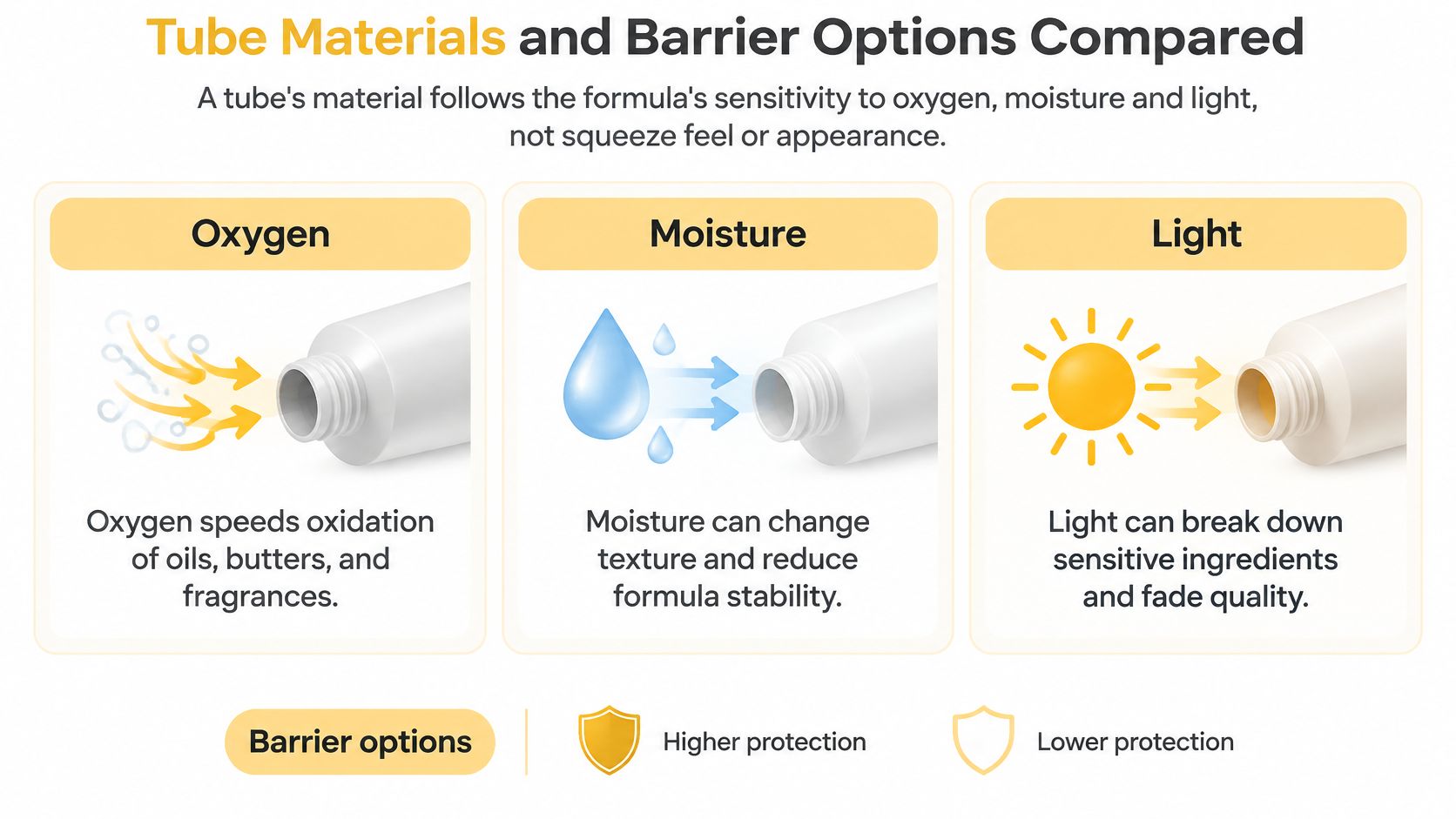
A balm loaded with citrus oils, butters, or antioxidant actives can smell rancid and change color long before the tube runs empty. Oxygen drives that failure: it accelerates oxidation of oils, fragrances, antioxidants, and other sensitive ingredients, producing rancid odor, color change, and texture drift, as the Cospaks cosmetic squeeze-tube buying guide explains.
So match the material to the formula's sensitivity to oxygen, moisture, and light. A soft, attractive tube can still be the wrong package for a balm that deteriorates during storage. The opposite mistake costs too: specifying an aluminum barrier for every formula adds complexity without a demonstrated benefit. A barrier layer works like insurance. You size the coverage to the actual risk, and paying for protection the formula never needs buys nothing.
Squeeze tube structures compared by protection and recovery
| Structure | Oxygen and light protection | Recovery profile | Best fit |
|---|---|---|---|
| Standard PE tube | Limited oxygen and light barrier | Mono-material designs are generally easier to process where accepted | Low-sensitivity balms that pass stability testing |
| PE with EVOH barrier layer | Improved oxygen barrier; light protection needs separate assessment | Multilayer construction requires recovery assessment | Oxygen-sensitive oil or fragrance systems |
| Aluminum laminate tube | Strong protection against oxygen, moisture, and light | Multi-material construction requires explicit local acceptance | Highly oxidation-sensitive balms |
| Plastic-barrier laminate tube | Improved barrier over standard PE; exact performance is construction-specific | Potentially better recyclability than aluminum structures | Formulas needing a balance of protection and recovery |
Standard polyethylene (PE) offers flexibility and broad chemical compatibility. Start there when stability testing permits, and remember that an opaque-looking wall still doesn't establish adequate oxygen protection.
An EVOH barrier layer improves oxygen resistance inside an otherwise plastic tube. It doesn't, by itself, establish light protection, so pigments or a secondary carton may still be needed for light-sensitive actives. Aluminum-barrier laminates address several exposure routes together. Plastic-barrier laminates offer another route when standard PE falls short and a mono-material recovery stream matters in the markets where you sell.
Turn barrier language into a specification
Practical rule: A supplier's high-barrier description isn't a measurable acceptance criterion.
Request the exact layer construction, barrier material, wall thickness, oxygen-transmission rate, and water-vapor-transmission rate. Ask for the test conditions and units too. Two suppliers can both advertise a high-barrier tube while measuring transmission at different temperatures and humidity levels, which makes their numbers impossible to compare.
Mylarmen's guide to packaging material types provides broader material-selection context for weighing these trade-offs across a full product line.
Take a rich bedtime balm. The pharmacist notes on nighttime lip dryness describe an overnight routine built around thick, occlusive layers. Formulas designed for that routine often carry higher loads of oils and butters, which means more substrate available for oxidation. The use case suggests a comfortable applicator and generous fill, while the ingredient list decides the barrier. An intended use isn't a material specification, and barrier figures alone don't establish whether the balm stays compatible with the sealant layer, adhesives, coatings, or printed decoration over its shelf life.
How Squeeze Tubes Dispense and Which Closures Fit
When the user compresses the body, pressure moves balm through the shoulder and orifice. The applicator spreads the delivered product, and the closure seals the tip afterward. If the formula is too firm for that pathway, the user may squeeze harder than expected and receive a sudden surge.
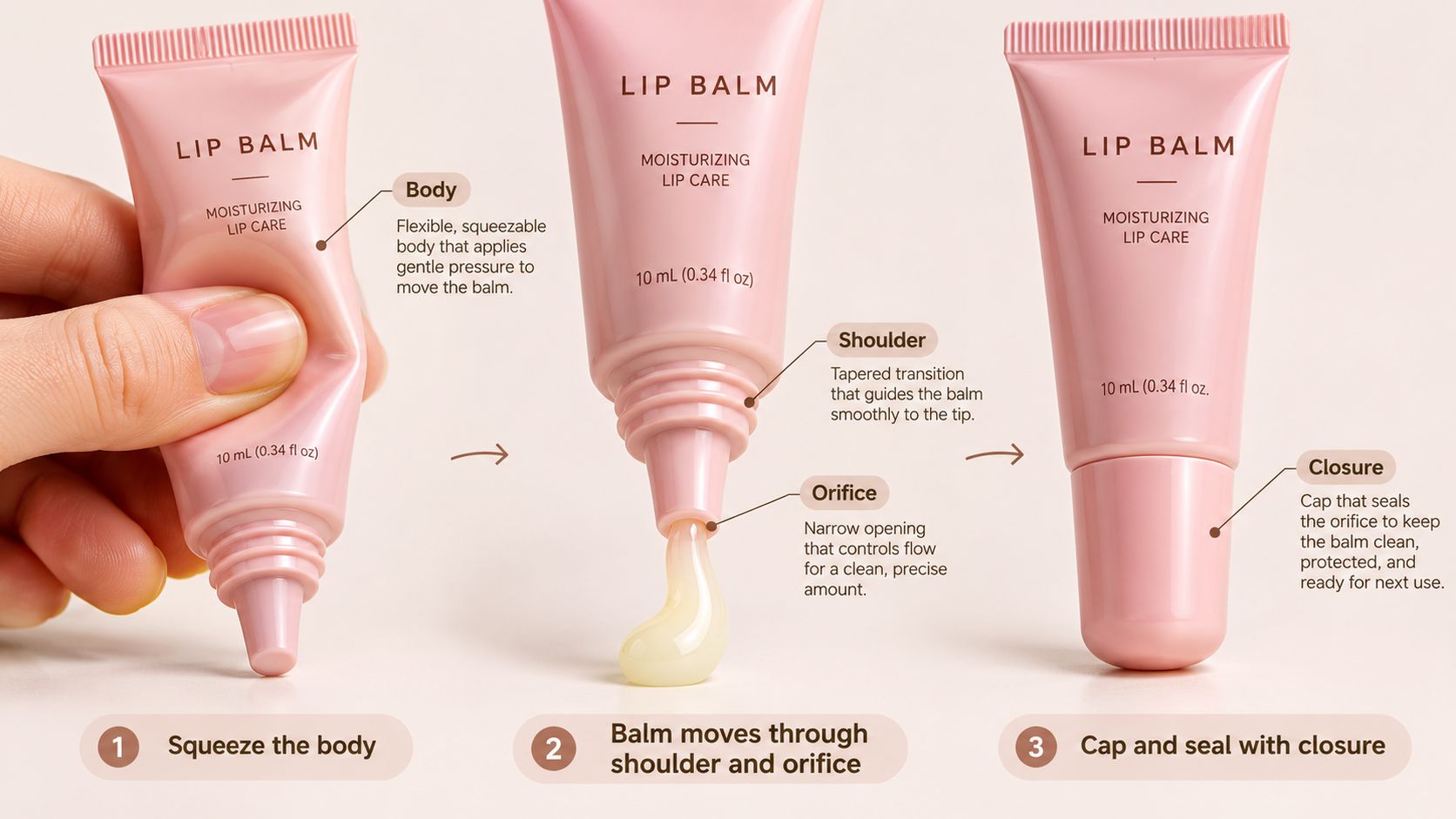
Orifice size, wall construction, and formula consistency work together. A larger opening can reduce dispensing resistance but make a soft balm harder to portion. A smaller opening can improve control yet frustrate users when the product firms up in cooler conditions.
Wall thickness and material stiffness affect squeezing effort and how the body recovers after pressure is released. They also influence how readily users can flatten the package to access remaining balm. At the opposite end, the filled tube's sealed tail must withstand handling and transport without opening or leaking.
Closure types for squeeze lip balm tubes
| Closure | How it dispenses | Strength | Watch-out |
|---|---|---|---|
| Flip-top cap | Thumb opens the lid; closing it covers the tip | One-handed access and tip protection | Hinge can fail; cap may use a different resin |
| Screw cap | Unscrew and set aside; tip is exposed while open | Secure closure when properly matched | Easy to lose; threaded construction can add cost |
| Snap-on cap | Pull off, then press back on | Simple construction and potentially low cost | Can loosen in a bag if retention is inadequate |
A closure should be evaluated on a filled tube, not just clicked open on an empty sample. Balm around the tip can interfere with seating, collect inside the lid, or make a cap slippery. Check whether the closed lid seals the dispensing opening rather than merely surrounding it.
A cap that feels secure at the desk still needs to stay closed during the product's intended use.
Use these criteria to narrow the options:
- Pocket use: Check retention, snagging, and whether incidental pressure can push product into the cap.
- Product firmness: Match the opening and squeezing effort to the actual balm, including changes with temperature.
- Unit budget: Compare the complete assembly and filling requirements, not just the quoted cap price.
Record the cap resin separately from the tube body. Matching appearance doesn't mean matching materials.
Recyclability in the Market Where the Tube Is Sold
A squeeze tube stamped with a recyclable resin code can still end up in landfill. The code describes what the plastic is. Recovery depends on the collection programs, sorting equipment, and package dimensions operating where the tube is sold, which makes recyclability a property of the destination market rather than the material itself.
That distinction changes how you evaluate a construction. A technically recyclable mono-material tube can fail at the sorting facility if its small size gets screened out of the stream. A barrier laminate that a sorting system rejects can still be the correct choice if a sensitive balm needs the oxygen or light protection to survive its shelf life. The formula's requirements and the recovery system's requirements run on separate tracks, and the spec has to satisfy both.
Rank the finished package, not the resin
Use these questions as a market-specific decision tool:
- Structure: Is the body mono-material, or does it contain a barrier layer that affects acceptance?
- Sorting: Will the finished tube's dimensions keep it in the intended recovery stream?
- Separation: Can consumers remove components when the local program requires it, without tools or confusing instructions?
- Instructions: Do the disposal directions match the collection system where the product is sold?
Mono-material LDPE structures are generally easier to process than constructions with incompatible barrier layers, but that advantage disappears if the tube is small enough to be screened out during sorting. Judge the full assembly before assigning an environmentally preferable label: shoulder, cap, label stock, and adhesive all factor into acceptance alongside the flexible body.
Give consumers instructions they can follow
There is no universal acceptable residue amount for lip balm tubes. Confirm the receiving program's emptying requirements and translate them into directions a person can complete in a few seconds. Skip the default rinse instruction: rinsing consumes water without making an unaccepted package acceptable.
Tell consumers to separate caps only where local guidance requires it. Avoid asking them to cut a tube open unless the recovery program explicitly calls for that step and the instruction can be given safely.
Recovery test: Name the intended collection route before approving a recyclability claim.
For broader context, ALODERMA's guide to greener packaging covers packaging decisions beyond appearance, and Mylarmen's sustainable packaging trends guide helps frame that review across materials and formats.
The trade-off comes down to sequence: protect the balm first, then find the most credible recovery route that construction can use in its destination market.
How to Spec a Squeeze Tube for Your Balm
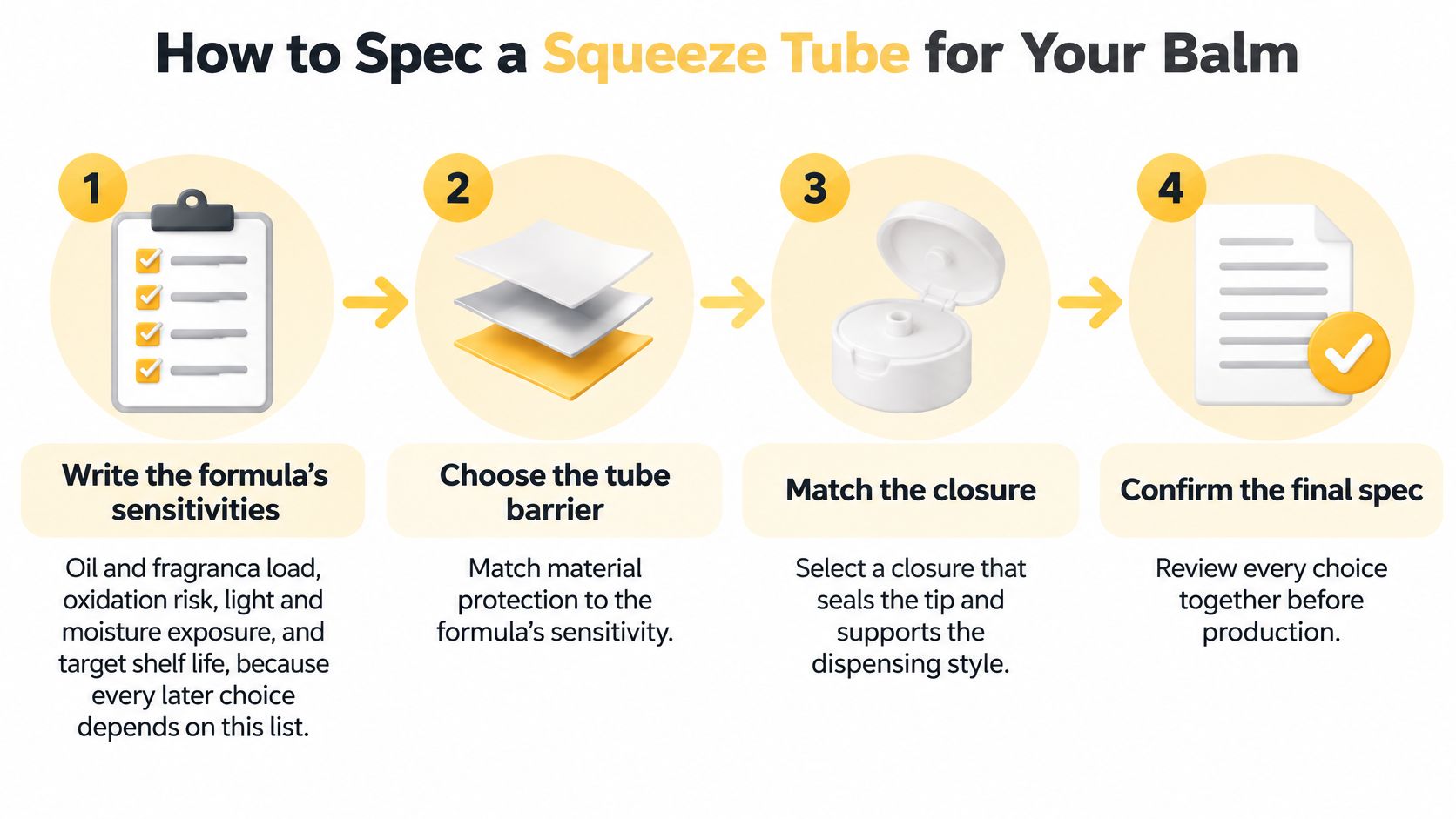
A useful specification connects the formula developer, tube manufacturer, filler, and artwork team. It should let each person identify what must be supplied, measured, and approved without guessing from a rendering.
Build the technical brief
Document the formula's sensitivities. Record the oil and fragrance system, known oxidation concerns, light and moisture sensitivities, and intended shelf life. Have the formulator identify uncertainties rather than leave the packaging team to infer them from an ingredient list.
Select a candidate structure. Use the material comparison to establish a starting point, then validate it. Don't default to aluminum if a plastic-barrier laminate can meet the product's requirements. Equally, don't downgrade protection solely to simplify the sustainability message.
Match the closure to use. Translate pocket use, product firmness, and budget into acceptance checks. For example, require the cap to close fully after normal application without forcing the user to wipe inaccessible recesses.
Set the body and dispensing geometry. Specify capacity, usable fill, applicator shape, and orifice against sample fills. Weigh the tube before and after representative applications to compare delivered amounts. A tip that floods or starves the user needs revision before decoration is approved.
Define evidence and approval
Request the supplier's technical specification. Obtain the complete construction and measured transmission data, with test conditions. Tie approved samples to a named material specification so a later substitution can't pass unnoticed because it looks similar.
Run compatibility and stability work. Establish a protocol with the formulator and testing team that evaluates the filled package over the planned shelf life. Examine odor, color, texture, leakage, wall distortion, seal integrity, and decoration performance. Include storage orientations that bring the balm into contact with the closure and sealed tail. Accelerated screening can help identify problems, but it shouldn't become an unsupported shelf-life claim.
Resolve recovery before printing. Apply the market assessment to the final component list, including labels and adhesives. Approve the disposal wording alongside the construction, and reopen that review if a supplier changes a component.
A passing specification combines documented protection, stable filled samples, and clean dispensing. It also identifies who approves changes and which changes trigger retesting.
Keep an approved physical sample with the signed drawing and test records. That reference gives production teams something more useful than a photograph when they need to distinguish an acceptable tube from a merely similar one.
Test the Spec Before You Commit to a Launch
Launch only when the paperwork and filled-package testing agree. An attractive prototype isn't sufficient if its material construction is undocumented. A complete supplier data sheet isn't sufficient if users can't dispense the balm comfortably.
Make the release decision against a short approval record:
- Formula and structure: The formulator has accepted the protection approach.
- Dispensing and closure: Filled samples meet the intended use requirements.
- Evidence: Measured barrier data and compatibility results are on file.
- Destination market: Recovery instructions have been checked for the finished package.
If a required approval is missing, hold final artwork release and the launch commitment rather than treating the missing information as an administrative detail.
A physical prototype is the practical next step because it reveals fit, closure feel, and dispensing behavior that a drawing can't show. Distinguish a visual mockup from a production-representative filled sample, since they answer different questions.
Our packaging design covers flexible and rigid packaging, including pouches, labels, boxes, and containers, drawn against real production tolerances with 3D mockups and die-lines. The Mylarmen packaging design guide provides context for connecting the technical brief to that design process.
For lip balm in squeeze tubes, approve what the user will hold and squeeze, not just what the launch presentation displays.
Mylarmen connects packaging design, structural engineering, and production support to help turn a technical brief into a manufacturable package. Visit Mylarmen with your balm's formula requirements, intended markets, and sample-fill findings to discuss a prototype and production-ready design brief.